
Web data schema design for analysts is the practice of organizing web-derived data into well-defined structures that support accurate querying, consistent metrics, and reliable reporting. Done right, it prevents the silent errors that corrupt dashboards and mislead decisions. Done wrong, it produces duplicate joins, broken aggregations, and metrics that mean different things to different teams. This guide covers the foundational principles, dimensional modeling patterns, semi-structured data challenges, and the best practices that separate production-grade schemas from brittle one-offs.
What are the foundational principles of web data schema design for analysts?
Defining the grain is the single most important step in any schema design process. The grain specifies exactly what one row in a fact table represents. Get it wrong and every aggregation downstream carries that error forward, and no amount of DISTINCT in SQL will fix it.
Beyond grain, every schema needs clearly defined primary keys, foreign keys, and cardinality relationships. One-to-many relationships are the norm in web data. Many-to-many relationships require a bridge table. Skipping this step causes duplicate join errors that inflate metrics and are notoriously hard to trace.

Normalization and denormalization serve different goals. Normalization stores each fact once, reducing update errors and keeping the source of truth clear. Denormalization precomputes or copies data to speed up reads. For analytical schemas built on web data, denormalization at the mart layer is common because read speed matters more than write efficiency.
Two additional principles apply specifically to web-sourced data:
- Provenance fields: Every table should carry a source URL and scrape timestamp. These fields make debugging extraction drift possible.
- Explicit nulls: Missing data must be stored as
NULL, not omitted or substituted with empty strings. Omission hides gaps; explicit nulls expose them.
Pro Tip: Before writing a single CREATE TABLE statement, write out your business questions in plain English. The grain, keys, and relationships will follow naturally from those questions.
How does dimensional modeling improve analysis on web data?
Dimensional modeling is the standard approach for analyst-friendly data structures in analytical warehouses. It separates data into two types of tables: fact tables that store measurable events, and dimension tables that store the context for those events.
The star schema is the most widely used pattern. One central fact table connects to multiple denormalized dimension tables. Fact tables stay narrow, carrying foreign keys and numeric measures. Dimension tables stay wide, carrying the attributes analysts use for filtering and grouping. This structure produces simple joins and fast reads, which matters when analysts run ad hoc queries against millions of web events.
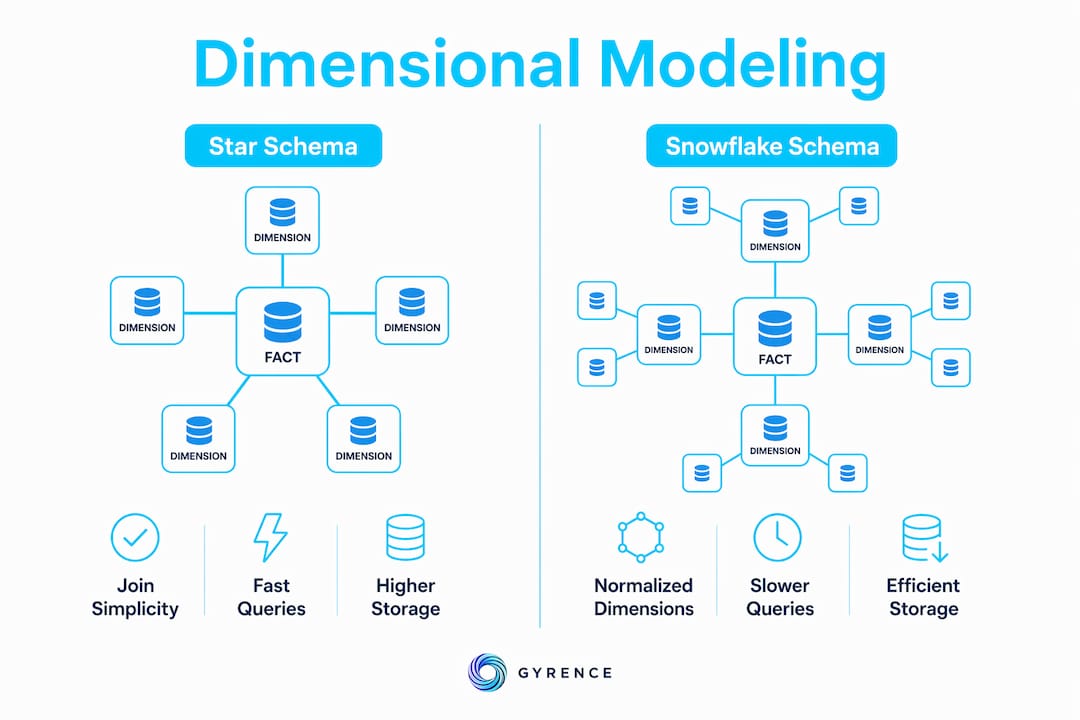
The snowflake schema normalizes dimension tables into sub-dimensions. This reduces storage but adds join complexity. Snowflake schema adds complex joins that often decrease query performance in modern columnar warehouses like BigQuery or Snowflake. Start with star schema. Move to snowflake only when a specific requirement justifies the tradeoff.
| Schema pattern | Join complexity | Query speed | Storage efficiency | Best for |
|---|---|---|---|---|
| Star schema | Low | Fast | Moderate | Most web analytics use cases |
| Snowflake schema | High | Slower | High | Highly normalized source systems |
Surrogate keys are non-negotiable in dimensional modeling for web data. Natural keys from scraped sources change. A surrogate key is a system-generated integer or UUID that stays stable even when the source data changes. This keeps your fact table joins intact across schema updates.
Pro Tip: Use surrogate keys on all dimension tables from day one. Retrofitting them after a source system changes its natural key is painful and error-prone.
What challenges arise when designing schemas for semi-structured web data?
Web-scraped data arrives in JSON, and JSON fields inside data platforms create real performance problems. Databricks warns that statistics collection and partitioning do not work inside JSON strings or maps. This means query planners cannot accelerate filters on those fields. The fix is to promote frequently filtered fields from JSON into dedicated typed columns.
Consistent data typing is the second major challenge. Web scrapers return numbers as strings, dates in inconsistent formats, and booleans as "true" or "1". Every numeric field must be stored as a number, not a string with units. Every date must follow ISO 8601 formatting to prevent silent comparison failures across time zones and locales.
The table below summarizes the most common semi-structured data problems and their schema-level fixes:
| Problem | Schema fix |
|---|---|
| JSON fields blocking query acceleration | Promote to typed columns |
| Dates as free-text strings | Standardize to ISO 8601 at ingestion |
| Missing values omitted entirely | Store as explicit NULL |
| Numbers stored as strings | Cast to numeric type at staging |
| Multi-value fields as flat strings | Store as arrays |
Provenance metadata rounds out the schema. Source URL and scrape timestamp belong on every raw and staging table. They are the first fields analysts check when a metric shifts unexpectedly. Without them, debugging extraction drift becomes guesswork. For a deeper look at structuring this kind of output for downstream use, the structured JSON extraction guide covers the ingestion side in detail.
What are the best practices and common pitfalls in schema design?
The most reliable schemas start from business questions, not diagrams. Database modeling starts from access patterns, not from premature normalization exercises. Know which queries analysts run most often before deciding on grain, partitioning, or indexing.
Layer your production models in three stages:
- Staging: Raw source data, lightly cleaned, one-to-one with source tables. No business logic here.
- Intermediate: Joined, typed, and deduplicated. This is where grain is enforced.
- Marts: Denormalized, aggregated, and named for business domains. These are what analysts query.
Separating these layers prevents inconsistent dashboard logic and makes it possible to test each layer independently. Add named tests on every model before release. A broken intermediate model that reaches a mart silently corrupts every downstream metric.
Semantic layers are the final safeguard. dbt's semantic model in YAML separates entities, dimensions, and measures. It constructs joins at query time rather than pre-materializing every combination. This means analysts across teams pull from the same metric definitions, not their own local interpretations. KPI inconsistency across dashboards is almost always a schema governance failure, not a data quality failure.
Pro Tip: Avoid modeling every possible use case before you have real query patterns. Build the staging and intermediate layers first, validate them with actual analyst queries, then build marts.
Key takeaways
Effective analytical schema design for web data requires defining grain first, modeling dimensions explicitly, and treating semi-structured inputs as a typing and provenance problem, not just a storage problem.
| Point | Details |
|---|---|
| Define grain before anything else | Incorrect grain causes aggregation errors that SQL cannot fix after the fact. |
| Use star schema as the default | Star schema produces faster queries and simpler joins than snowflake in most web analytics contexts. |
| Promote JSON fields to typed columns | Leaving data in JSON maps blocks query acceleration and partitioning in platforms like Databricks. |
| Add provenance fields to every raw table | Source URL and scrape timestamp are the first tools for debugging extraction drift. |
| Layer staging, intermediate, and marts | Separating layers keeps business logic testable and prevents silent metric corruption. |
Schema design is messier than the textbooks admit
The textbook version of dimensional modeling assumes clean, well-typed source data arriving on a predictable schedule. Web data is none of those things. I have seen analysts spend more time debugging a broken scrape timestamp than building the entire mart layer above it.
The honest lesson is that schema design for web data is a collaboration between analysts and the people managing extraction. Analysts need to specify what fields matter and at what grain. Extraction engineers need to commit to consistent typing and explicit nulls at the source. When those two groups do not talk, you get schemas that look correct in a diagram and fail in production.
The other thing I have learned is that over-modeling early is a real trap. Teams spend weeks building a perfect snowflake schema for a use case that turns out to need three columns and a simple filter. Start with the questions, build the simplest schema that answers them, and refine based on actual query patterns. Iterative refinement beats upfront perfection every time. The web data quality standards guide covers how to build validation into that iteration cycle.
— Glen
How Gyrence supports structured web data for analyst pipelines
Getting web data into a schema-ready state requires more than a scraper. It requires typed output, explicit failure modes, and provenance fields baked in from the first API call.
Gyrence is built for exactly this. Its Extract primitive returns structured JSON against a prompt or schema, with every response typed as a discriminated union so your pipeline knows whether a call succeeded, partially failed, or returned nothing. Provenance fields like source URL are part of the response contract, not an afterthought. Spending caps mean your ingestion bill stays predictable while you iterate on schema design. Data teams building analysis-ready web data infrastructure can connect via REST API or the hosted MCP endpoint and start pulling typed, structured data in minutes.
FAQ
What is the grain in a data schema?
The grain defines what a single row in a fact table represents. Defining grain correctly prevents aggregation errors and duplicate joins that inflate metrics.
When should analysts use star schema vs. snowflake schema?
Star schema is the right default for web analytics. Snowflake schema adds join complexity that slows queries in columnar warehouses without meaningful benefit for most analyst use cases.
Why do provenance fields matter in web data schemas?
Provenance fields like source URL and scrape timestamp are the primary tools for diagnosing metric shifts caused by extraction drift or source changes.
What is a semantic layer and why does it reduce KPI errors?
A semantic layer, such as dbt's YAML semantic model, defines metrics once and constructs joins at query time. This prevents analysts from building conflicting local metric definitions.
How should missing data be handled in web-scraped schemas?
Missing fields must be stored as explicit NULL values. Omitting fields entirely hides data gaps and causes silent errors in aggregations and filters.