
Source-traceable extraction means every value you pull from the web carries the evidence that produced it: the URL, the exact passage, the time you saw it and the state of the page. Ordinary scraping gives you a field. Traceable extraction gives you a field you can defend. Gyrence is built around that distinction: Fetch, Extract and the other primitives return typed responses, failure cases included, so your pipeline can record what happened instead of guessing.
TL;DR
- Traceability is enforced per value, not per document. Each extracted field needs its own source URL, quoted passage and timestamp.
- Keep the requested URL, the final URL after redirects, the HTTP status and the fetch time with every page.
- Verify mechanically: if a field's quoted span does not appear in the page text, treat it as unverified, whatever the model's confidence says.
- Changed, missing and blocked pages must be recorded states, not silent gaps.
- Predictable per-call cost matters here, because re-fetching to verify is the whole point.
Table of Contents
- What source-traceable extraction actually is
- What to record for each value
- Keep the link from search to structured output
- Verify the quoted span, not the confidence score
- Handle changed, missing and failed sources
- Use it from agents and RAG pipelines
- Cost: verification means re-fetching
- Choosing an extraction API for this job
- Perspective
- Start building with traceable calls
- FAQ
- Sources
What source-traceable extraction actually is
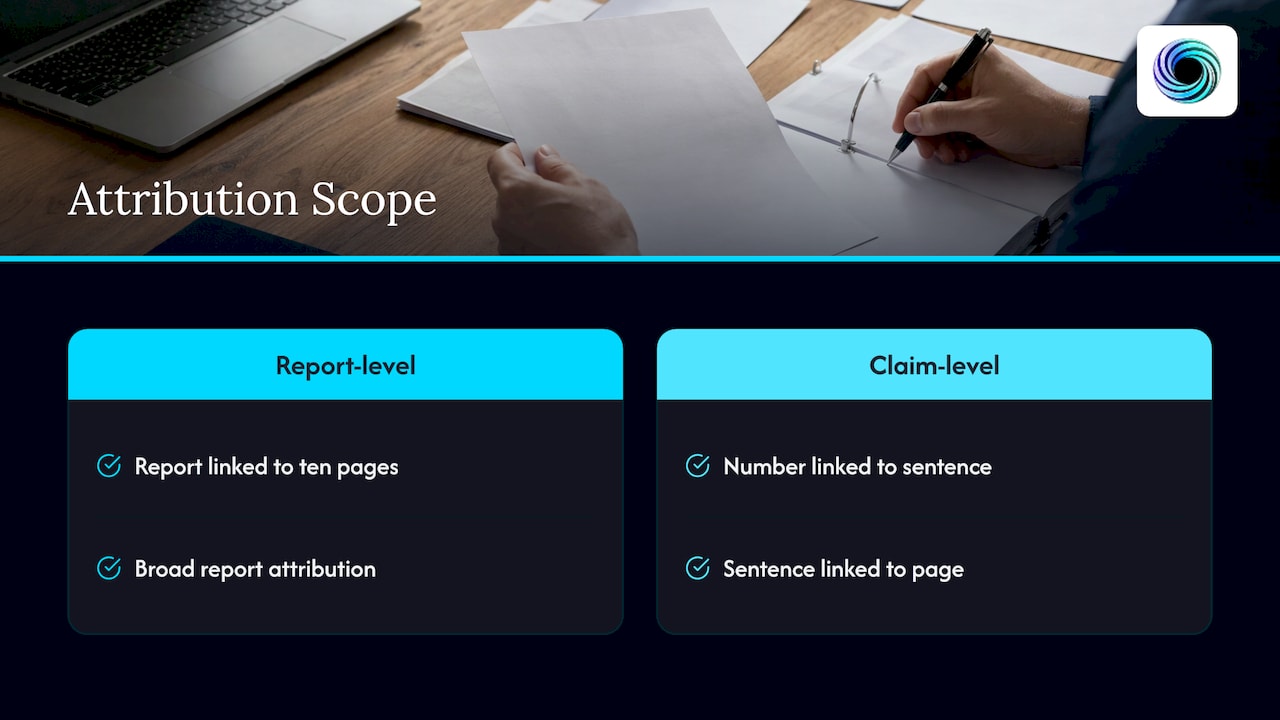
LlamaIndex's glossary describes citation-grounded extraction as pulling claims or data points from documents while linking each one to its originating citation. The key phrase is claim-level attribution: not "this report came from these ten pages," but "this number came from this sentence on this page."
That matters most if you build compliance, financial-research or market-intelligence workflows, where an analyst or auditor will ask where a number came from. It matters for AI agents too: an agent that cites sources needs the source attached to the data before the model ever writes a sentence. For a broader treatment of the citation side, see our guide to shipping verifiable source citations for AI. For general discussion of attribution in generative systems, see this piece on citations in generative engines.
What to record for each value
A useful minimum, drawn from Reliable Context's value-level evidence register, is one record per value, even when several values share a document:
| Field | Why it exists |
|---|---|
| Value and scope | What the number means (period, unit, entity) |
| Source URL | Where it was read |
| Verbatim passage plus locator | Heading, section, page, row or quote |
| Source publication or version date | Separates "when published" from "when seen" |
| Observation and record times | When you fetched it and when you stored it |
| Captured state with checksum | Lets you detect a different byte stream later |
| Archive date and locator | A copy to point to if the page changes |
| Recheck disposition | For example, changed, so recompute the current value |
At the fetch level, the Sekin team's RAG collection guide recommends keeping the requested URL, the final URL after redirects, the fetch time, the response status and content metadata. Passages should also carry canonical and original URL, page title, retrieval timestamp, HTTP status, publication or update metadata, and extraction and chunk identifiers.
The vocabulary is not new. The W3C's PROV data model, a Recommendation from 30 April 2013, defines the shared provenance concepts this kind of record builds on. If your auditors already think in provenance terms, map your fields to it early.
Two cautions keep the record honest. ModelFold's editorial team notes that provider location metadata and confidence scores help inspection but do not establish correctness. A content digest flags that bytes differ, but does not prove authenticity or authorship. Treat the record as evidence to review, not proof.
Keep the link from search to structured output
Traceability breaks at handoffs. A search step returns URLs, a fetch step returns text, an extraction step returns JSON, and somewhere the URL gets dropped. The fix is to make the source identifier part of the data contract from step one:
- Search. Store the query, the result URL and the rank or snippet that led you there.
- Fetch. Store the requested and final URL, status and fetch time next to the cleaned markdown. Gyrence Fetch returns a page cleaned to markdown in a typed response.
- Extract. Define a schema where every field has a companion
source_textandsource_url. Gyrence Extract returns structured JSON from a prompt or schema. - Verify. Run the span check described below before anything is written to your store.
- Monitor. Decide which values must be rechecked, and on what trigger.
If you crawl rather than search, Traverse starts from a URL and moves outward, and Map lists a domain's URLs, so the discovery path is itself a record you can keep. Our step-by-step on web data provenance tracking covers the pipeline in more detail, and the schema-guided extraction write-up covers how to design the schema.
Verify the quoted span, not the confidence score
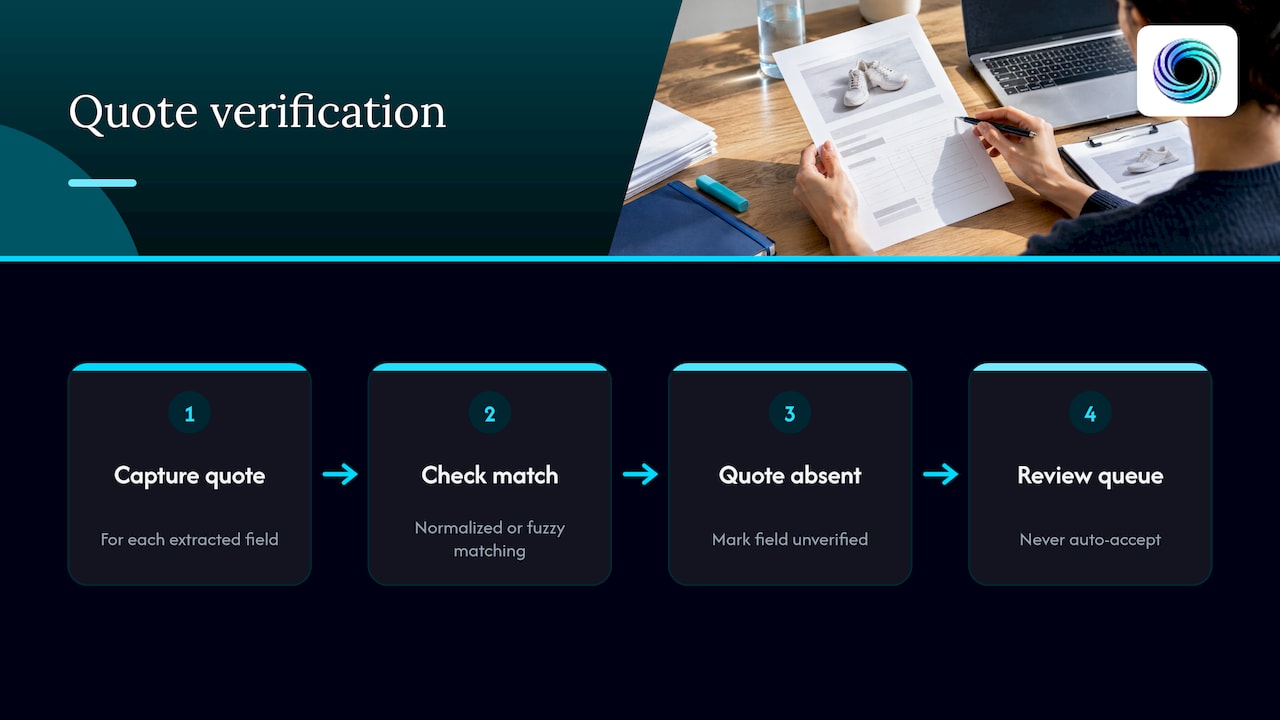
Frontier Engineering's extraction-with-provenance pattern wraps every extracted field in a container whose source_text is quoted verbatim from the document. Each span is then checked mechanically with normalized or fuzzy matching. A field whose quote does not appear in the page is unverified and is never auto-accepted, regardless of the model's stated confidence.
A minimal version looks like this:
field: { value: 4.2, source_text: "revenue grew 4.2% year over year" }
check: normalize(page_text).contains(normalize(source_text))
result: verified | unverified
The same pattern argues that forcing a quote suppresses fabrication, since a model that must cite its words is less willing to invent them, and that an unverified span is a stronger warning than a low confidence number. Route unverified fields to a review queue, not to your dashboard.
Handle changed, missing and failed sources
A traceable pipeline treats failure as data. Pages move, redirect, block you or change under a stored value. Four states cover most cases:
- Fetched and verified. Store the record and move on.
- Fetched, span not found. Mark unverified and queue for review.
- Fetch failed. Store the status and reason. Do not substitute an old value without labeling it stale.
- Fetched, content changed. Compare against the stored checksum, set the recheck disposition, and recompute the value.
This is where the response format matters. Gyrence returns a typed, discriminated-union response for every call, including failures, so your code branches on an explicit result type instead of parsing an empty string. Our typed-error extraction pipeline walks through all six stages. For recurring checks on pages you already depend on, WebDoppler provides monitoring with webhook alerts, so a change can trigger your recheck.
Use it from agents and RAG pipelines
For RAG, the provenance rides with each chunk: canonical URL, retrieval timestamp, status and chunk ID in the metadata, so a retrieved passage can always be shown with its origin. For agents, Gyrence offers a hosted MCP endpoint, so an MCP client such as a custom agent can call the same primitives as tools. Because the failure cases come back typed, the agent can say "the source was unreachable" instead of filling the gap.
Context size interacts with this. Passing whole pages into a prompt burns tokens and dilutes the quote you need; see our notes on the LLM context window and web data. Regulated teams will find the same principles applied in web data for regulatory research and ESG data from the web.
Cost: verification means re-fetching
A traceable workflow fetches more than a naive one: you recheck, you re-verify, you archive. That is exactly when per-call surprises hurt. Gyrence bills in credits with predictable cost per call and spending caps, and there is no separate AI extraction charge, so adding an Extract step does not add a second meter. Set the cap before you schedule rechecks, then size the recheck cadence to the budget.
Choosing an extraction API for this job
For traceable work, check these before anything else:
- Does every response, failures included, have a typed shape you can branch on?
- Do you get the final URL, status and timing, not just the body?
- Can extraction be guided by a schema so quoted fields line up with your record?
- Can you cap spend and predict cost per call?
- Is there an MCP endpoint if your agents need the tools directly?
Our notes on what makes a scraper LLM-friendly and on structured extraction benefits for dev teams expand on each point.
Perspective
Most extraction tools optimize for the happy path: a page loads, a field comes back, everyone moves on. Provenance is decided on the unhappy path. When a page redirects, blocks, changes or quietly returns nothing, a pipeline either records that fact or hides it.
We built Gyrence to be honest by design. Every primitive returns a typed response, including the failures, so the evidence trail does not depend on someone remembering to log an error. Add curated source metadata, drift detection and capped, predictable billing, and the cost of keeping evidence stops being a gamble.
If a value can't be traced, it shouldn't be trusted. That is the standard we hold the API to.
Glen
Start building with traceable calls
Gyrence offers Free, Founders and Pay-As-You-Go options, plus Standard at $75 per month, Growth at $299 per month and Scale at $549 per month. Compare them on the pricing page, or set up change alerts with WebDoppler.
FAQ
How is source-traceable extraction different from scraping?
Scraping returns data. Traceable extraction returns data plus the URL, the quoted passage, the fetch time and the page state behind each value. The attribution is at the level of the individual claim, not the document.
Is a confidence score enough to trust an extracted value?
No. Confidence scores help inspection but do not establish correctness. A mechanical check that the quoted source text appears in the page is a stronger signal.
What should I store besides the URL?
Store the final URL after redirects, HTTP status, fetch time, a verbatim passage with its locator, the source's publication or version date, and a checksum of the captured state. Add a recheck status so changed pages are recomputed.
How do I keep costs predictable when I re-verify often?
Set a spending cap and use per-call credit pricing, then size your recheck schedule to it. With Gyrence there is no separate AI extraction charge, so an Extract step does not add a second bill.
Sources
- What is Citation-Grounded Extraction?
- How to Preserve Evidence When a Cited Source Changes
- Make Every Extracted Field Traceable to Its Source Evidence
- Web Scraping for RAG: A Practical Collection and Preparation Guide
- Extraction with Provenance, AI Design Pattern
- PROV-DM: The PROV Data Model