
Agent-safe web scraping means three things. The agent treats every page as untrusted input. It respects the site's access signals. It gets typed results, failures included, so it never has to guess. If you build for those three, most of the other problems (prompt injection, legal exposure, runaway bills) get smaller.
This guide walks through the architecture, the pre-flight checks, the failure handling and the cost controls.
TL;DR
- Split page acquisition from interpretation. Fetch first, extract second, validate before anything is stored or acted on.
- Treat page text as data, never as instructions. Keep extraction tools away from credentials and consequential actions.
- Check robots.txt, terms of use and access controls before you scrape. Prefer authorized channels where they exist.
- Require typed responses that include failure cases, and cap spend so a looping agent cannot run up a bill.
- Keep a source URL and fetch time on every record so each value can be traced back.
Table of Contents
- What "safe" means when an agent is the scraper
- Separate acquisition from interpretation
- Check access before you scrape
- Make failures first-class
- Keep every value traceable
- Connect the agent through MCP
- Control cost before the agent does
- Try it on a small run
- FAQ
- Sources
What "safe" means when an agent is the scraper
A human running a one-off script notices when something looks wrong. An agent does not. It will retry, follow links and act on whatever text it reads, at machine speed. That changes the failure modes.
TechTarget describes web scraping as pulling data from a source, parsing it for useful information and outputting it for an application. With an agent in the loop, the parsing step is often an LLM. That is where the new risk lives: the page content is now input to a model that can call tools.
The failure modes worth designing against:
- Injected instructions. A page contains text meant to redirect the agent.
- Silent partial results. A blocked or empty page gets summarized as if it were real data.
- Scope creep. The agent follows links well past the task.
- Unbounded cost. A retry loop or a deep traversal burns credits.
- Untraceable values. Nobody can say which page a number came from.
Separate acquisition from interpretation
The cleanest pattern is two layers. An access layer obtains an eligible page snapshot. An extraction layer produces candidate records tied to that snapshot. Those records are then checked for required fields, source support, completeness and freshness, as described in this design guide on access and extraction layers.
In practice that gives you a pipeline:
- Search for candidate URLs, or start from a known one.
- Fetch the page and clean it to markdown.
- Extract structured JSON against a schema.
- Validate the result: are required fields present, does the value appear in the snapshot, is it recent enough?
- Store the record with its source URL and fetch timestamp.
The same guidance says to keep extraction tools isolated from credentials and consequential actions, and to never let source text change the collection scope or send data somewhere else. Concretely: the model that reads a web page should not also hold your database write token or the ability to send email.
Why markdown at the fetch step? Raw HTML is noisy and expensive in tokens, and models misread it. We cover this in why agents fail on unstructured HTML.
Check access before you scrape
Safe also means defensible. Before the first request, check:
- robots.txt. Ropes & Gray's May 2026 legal guidance on web scraping describes it as a site-root file that tells crawlers which areas they may access. It is not itself an enforcement mechanism, so treat it as a meaningful signal rather than something to route around. A quick way to see what a site allows is a robots.txt checker.
- Terms of use. The same guidance says scrapers should comply with data owners' terms of use and technological protection measures.
- Authorized channels. If the site offers a paid API or licensed feed, the guidance points to using it.
- The nature of the data. Personal or confidential data raises the stakes. Consider it before you collect, not after.
- Your own promises. The FTC's January 2024 guidance says AI companies must honor privacy and confidentiality commitments made in terms of service and promotional materials. Secretly using customer data to train or update models can expose a company to FTC action. If scraped data feeds a model, check what you told your users.
This is engineering guidance, not legal advice. If your workflow touches personal data, paywalled content or a site that has objected to scraping, talk to a lawyer who handles data and IP matters in the U.S. before you ship.
For rate limits, schema design and PII controls, see our guide to ethical web scraping.
Make failures first-class
Most agent bugs in scraping come from one habit: APIs that return a 200 with a partial or empty body, or an error string the model then "reads" as content. The agent cannot tell a blocked page from a short page.
The fix is a typed response where success and failure are different shapes. A discriminated union looks like this:
{ "status": "ok", "url": "...", "markdown": "...", "fetched_at": "..." }
{ "status": "blocked", "url": "...", "reason": "access_denied" }
{ "status": "empty", "url": "...", "reason": "no_content" }
Now the agent branches on status instead of interpreting prose. Retry policy, escalation to a human and logging all key off a field, not a guess. Our write-up of common AI agent scraping mistakes covers the usual offenders, and the AI agent web browsing checklist turns this into a pre-launch review.

Keep every value traceable
For compliance and financial research, a number without a source is a liability. Store, per record:
- the source URL
- the fetch timestamp
- the snapshot or content hash the extraction ran against
- the schema version used
Then your validation step can reject any extracted value that does not appear in the snapshot. That one check removes a large share of hallucinated fields. For the extraction side, see our guide to structured JSON extraction, and for regulated data, structured financial data extraction.
Connect the agent through MCP
The Model Context Protocol gives an agent a standard way to call tools. That is useful for safety because you decide which tools exist. Expose search, fetch and extract. Do not expose a generic "run anything" tool. Keep credentials out of the agent's context, and set the scope per workspace.

We go deeper in MCP web scraping and, for framework wiring, in connecting a web scraping API to an AI agent. For the discovery step, see web search tools for autonomous agents.
Control cost before the agent does
An agent that loops is a billing risk. The usual causes:
| Cost driver | What to do |
|---|---|
| Retries on failing URLs | Cap attempts per URL; stop on typed blocked results |
| Deep traversal | Set depth and page limits before the run |
| Separate charges for LLM extraction | Ask whether extraction is bundled or billed on top |
| No spend ceiling | Use a hard spending cap per workspace |
| Repeat fetches of unchanged pages | Monitor for change instead of re-polling |
When you compare providers, line up the same things: which primitives are included, how failures are billed, whether extraction costs extra, whether caps are enforced, and what the plan tiers cost. Published pricing beats "contact sales" for anything you need to forecast.
Our take: honesty is a safety feature
Most scraping incidents we hear about are not exotic. An agent got an empty page, the vendor returned it as a success, and the model filled the gap. The web is a storm: pages change, block, time out and sometimes lie. A tool that hides that from the agent is not safe, however fast it is.
That is why we build Gyrence around typed responses. Search, Traverse, Fetch, Extract and Map all return a discriminated union, so a blocked page is a
blockedresult and not a paragraph of plausible text. Extraction is bundled, with no separate AI charge, and spending caps are part of the workspace, so your bill does not surprise you.We would rather tell you what failed than hand you something that looks finished.
Glen
Try it on a small run
Gyrence is a web data API with five primitives (Search, Traverse, Fetch, Extract, Map) and a hosted MCP endpoint. Every call returns a typed response, failures included, and spending caps are built in.
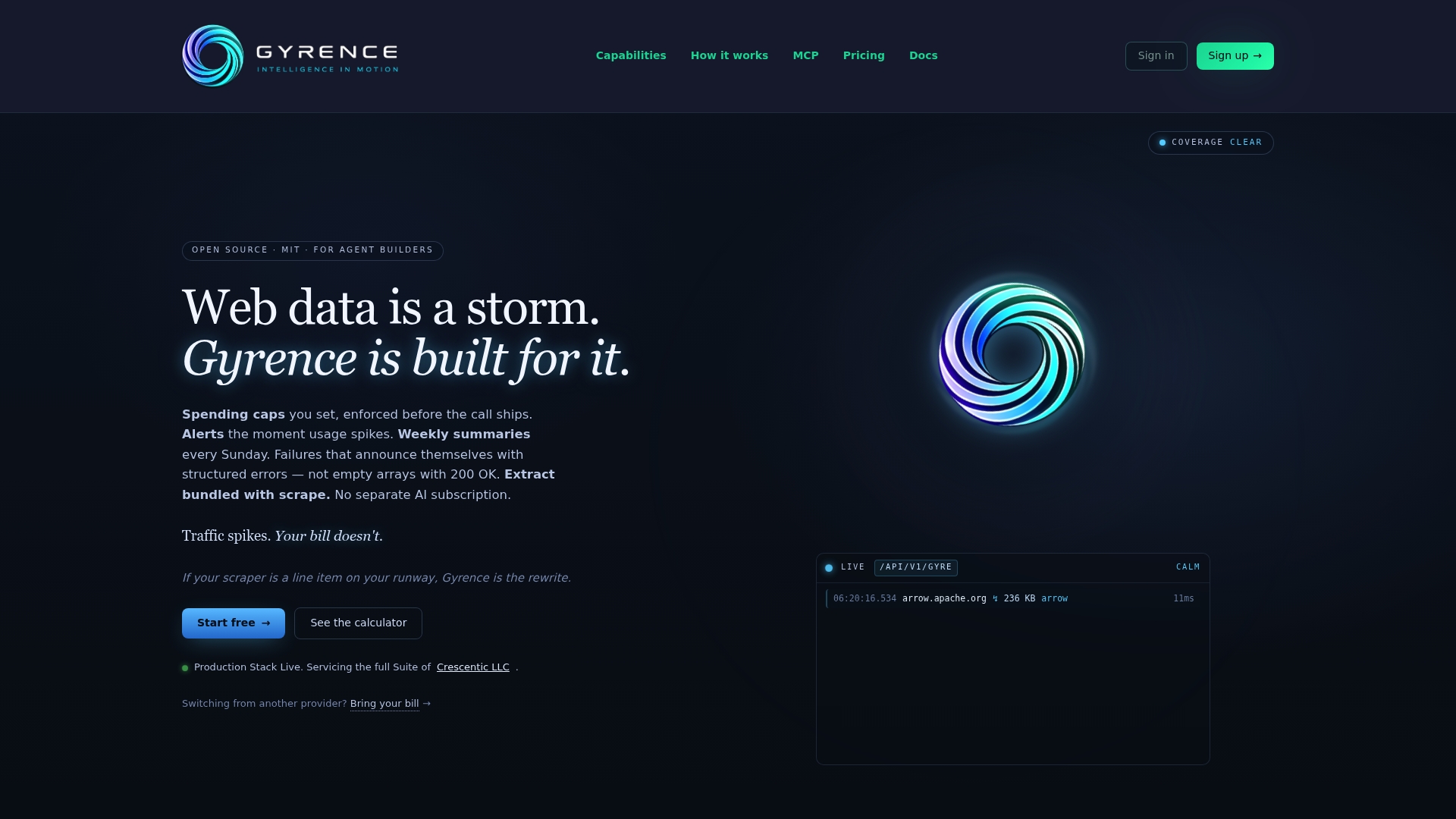
Plans on the pricing page include Free, Founders and Pay-As-You-Go, plus Standard at $75 per month, Growth at $299 per month and Scale at $549 per month. If you need to know when a page changes rather than re-fetch it, look at WebDoppler, which monitors pages and sends webhook alerts. Start from the Gyrence homepage and run one agent task under a low cap.
FAQ
Is it legal for an AI agent to scrape a website?
It depends on the site, the data and how you collect it. U.S. legal guidance points to complying with terms of use, robots.txt and technical protection measures, and to using authorized channels such as paid APIs where they exist. Personal data and confidential data need extra care, so get legal advice for anything sensitive.
Does robots.txt stop a scraper?
No. It is a signal, not an enforcement mechanism. A well-behaved agent reads it and honors it, and a safe pipeline checks it before the first fetch.
How do I stop prompt injection from web pages?
Treat page content as untrusted data. Keep the model that reads pages away from credentials and consequential actions, and do not let page text change your collection scope or send data elsewhere. Validate extracted records against the snapshot before using them.
How do I keep scraping costs predictable?
Set a hard spending cap, limit retries and traversal depth, and confirm whether LLM extraction is billed separately. Monitor pages for change instead of polling them repeatedly.
Sources
- How to Design Web Scraping Access and Extraction Layers for AI Agents
- How to scrape data from a website, TechTarget
- Web Scraping in the Age of AI: Guidance for Data Owners and Scrapers, Ropes & Gray
- AI Companies: Uphold Your Privacy and Confidentiality Commitments, FTC