
A web search tool for autonomous agents is a structured API or service that lets AI systems autonomously find, retrieve, and extract web content with predictable outputs and defined failure modes. Unlike a browser or a chatbot plugin, these tools must return typed, machine-readable responses that an agent can act on without human review. The Model Context Protocol (MCP) has emerged as the key open standard for connecting agents to external tools like web search. Developers building agentic web browsing systems need to understand MCP, latency budgeting, and structured extraction before choosing any tool.
What features and standards does a web search tool for autonomous agents need?
A production-grade web search tool for autonomous agents must expose a structured JSON-RPC interface with well-defined input schemas and typed output. Agents cannot tolerate ambiguous responses. Every call must return a result the agent can parse, including the failure cases.
MCP is an open standard that defines how AI clients invoke external tools using JSON-RPC interfaces, reducing the glue code developers write to wire tools into agents. MCP exposes each tool with a structured description and input schema. The client uses that schema to generate correct tool calls automatically, without custom parsing logic.
Key capabilities a web search tool must provide:
- Structured tool descriptions with input/output schemas the agent can read at runtime
- Typed, discriminated-union responses that include both success payloads and failure modes
- Metadata fields such as URL, ranking, and publication date alongside content
- Bundled extraction so the agent receives clean text or JSON, not raw HTML
- Spending caps and daily limits to prevent runaway costs in production
MCP tool metadata inflation can increase token usage and cost. Techniques like compact tool descriptions and Tool Search address this by preserving effectiveness while reducing overhead. This matters at scale: a single agent workflow may invoke a search tool dozens of times per session.
Pro Tip: Register your MCP tool descriptions with the smallest schema that still produces correct calls. Verbose descriptions inflate every prompt that includes the tool context.

How do latency and retrieval iteration affect multi-step agent workflows?
Latency compounds fast in multi-step retrieval. A single retrieval step at ~500ms yields a 1.5-second delay across three iterations. That is before any LLM inference time. In an agent that runs five or more retrieval steps, unchecked latency makes the system feel broken.
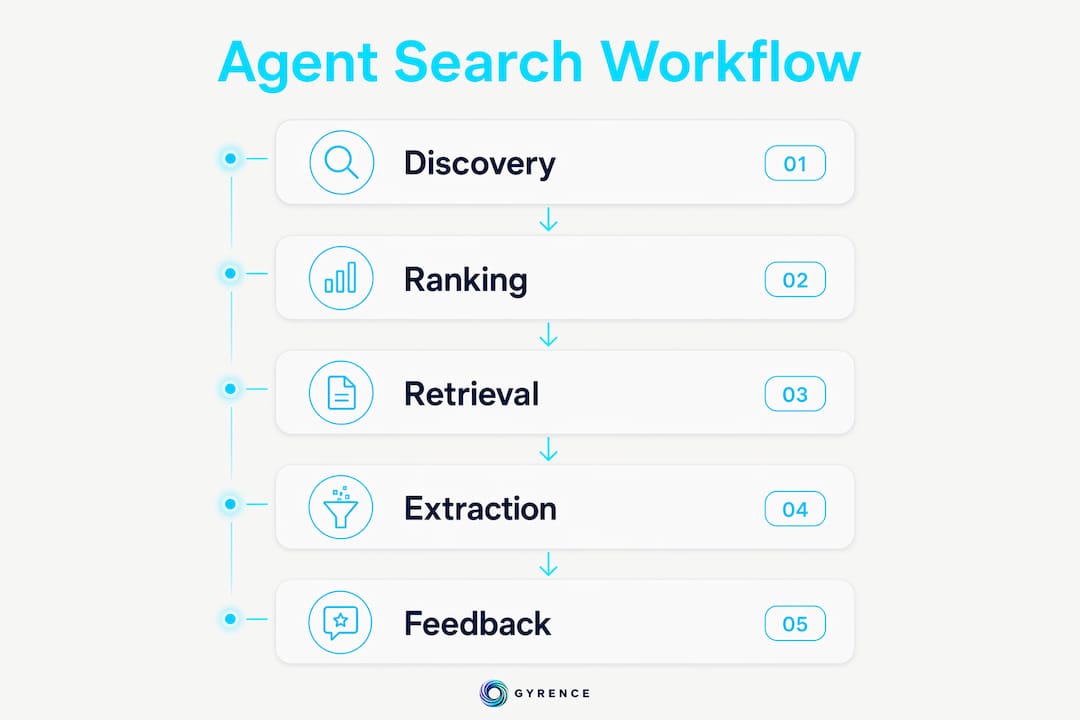
Agentic retrieval differs from static retrieval because agents decompose queries dynamically, select sources on the fly, and refine queries based on intermediate results. Each refinement adds a round trip. The practical target is sub-100ms retrieval per step, which requires caching, connection pooling, and careful API selection.
Three techniques that keep latency under control:
- Cache aggressively. Return cached results for repeated queries within a session. Most agents re-query the same URLs more than once.
- Use span-level tracing. Span-level instrumentation reveals model calls, cache hits, and retrieval times, turning debugging from guesswork into root cause analysis.
- Set hard timeouts per step. A retrieval call that hangs for 10 seconds is worse than a fast failure. Fail fast and let the agent retry with a different query.
Pro Tip: Instrument every retrieval call with a unique trace ID. When a workflow slows down in production, you need execution lineage, not just aggregate latency metrics.
Why should developers separate discovery from content extraction?
Discovery and extraction are two distinct operations, and treating them as one is the most common source of wasted cost and latency in agent pipelines. Discovery returns metadata: URLs, rankings, publication dates, and snippets. Extraction returns full page content. Fetching full content for every search result is expensive and slow.
Production pipelines separate these stages to allow quality versus latency trade-offs. The agent runs discovery first, scores the results, then extracts content only from the top candidates. This pattern cuts extraction calls by 60–80% in most workflows.
| Stage | Output | When to use |
|---|---|---|
| Discovery | URLs, rankings, snippets, dates | Always, as the first step |
| Extraction | Full text, structured JSON, markdown | Only for top-ranked results |
| Live crawl | Fresh content from the live page | When freshness is critical |
| Cached content | Stored page snapshot | When speed matters more than freshness |
Configurable controls like crawl timeouts and character limits give developers fine-grained cost management at the extraction stage. A character limit of 5,000 per page is often enough for an LLM to answer a factual question. Full-page extraction is reserved for deep research tasks. Developers building LLM-friendly markdown pipelines benefit most from this separation.
How can developers integrate feedback mechanisms into agentic search workflows?
Feedback loops let agents signal relevance quality back to the search tool, improving future results without manual tuning. The mechanism is simple: after a search returns results, the agent submits a structured feedback payload tied to the original search ID. The tool uses that signal to adjust ranking or refund credits for poor results.
Feedback integration works best when it runs in the background, not in the critical path of the agent's main workflow. A blocking feedback call adds latency to every search step. A non-blocking, fire-and-forget call preserves agent speed while still improving relevance over time.
Key design constraints to respect:
- Idempotency per search ID. Only the first feedback call per search ID should trigger a credit refund. Duplicate calls must be no-ops.
- Daily credit caps. Credit refunds stop when the daily cap is reached, which prevents feedback from becoming a cost exploit.
- Disable in testing. Feedback tools should be toggleable. Running feedback in a test environment pollutes production relevance signals.
- Decouple from agent logic. The agent should not branch on feedback outcomes. Feedback is a background quality signal, not a control flow mechanism.
What steps should developers follow to choose and implement an agent search tool?
Choosing the wrong tool costs weeks of refactoring. The evaluation should happen before any code is written.
- Define your retrieval contract. Specify what the agent needs: metadata only, full text, structured JSON, or markdown. This determines which extraction capabilities are non-negotiable.
- Check MCP compatibility. A tool that exposes an MCP endpoint reduces integration time significantly. Verify that the tool description schema matches your agent framework's expectations.
- Evaluate latency under load. Test with realistic query volumes. A tool that performs well at one request per second may degrade at 50 concurrent requests.
- Audit failure modes. The tool must return typed errors, not silent nulls or HTTP 200 responses with empty bodies. Agents that cannot distinguish a failed search from an empty result will hallucinate.
- Review pricing structure. Separate discovery and extraction pricing is a signal of a well-designed API. Flat-rate pricing that bundles both stages makes cost management harder.
- Instrument from day one. Wire span-level tracing into your first integration. Retrofitting observability into a production agent is painful. A web data API evaluation checklist covers the full set of criteria worth reviewing before committing.
Key Takeaways
A web search tool for autonomous agents requires MCP compatibility, typed failure modes, separated discovery and extraction stages, and span-level latency instrumentation to function reliably in production.
| Point | Details |
|---|---|
| MCP is the integration standard | Use MCP-compatible tools to reduce glue code and enable automatic tool call generation. |
| Latency compounds across steps | Target sub-100ms retrieval per step and use span-level tracing to find bottlenecks. |
| Separate discovery from extraction | Run discovery first, then extract content only from top-ranked results to cut costs. |
| Feedback loops run in background | Submit relevance feedback asynchronously per search ID to avoid blocking the agent. |
| Typed failure modes are non-negotiable | Agents must receive structured errors, not silent failures, to reason correctly about results. |
Why I think most teams underestimate the plumbing
Most developers I talk to focus on the LLM choice and ignore the retrieval layer until something breaks in production. That is backwards. The LLM is the easy part. Web data is a storm: pages go down, content changes, crawlers get blocked, and latency spikes without warning. The retrieval layer is where agent reliability actually lives.
The teams that ship reliable agents treat their search tool as infrastructure, not a utility. They instrument it, set spending caps, and define explicit failure contracts before writing a single prompt. They also separate discovery from extraction from day one, even if their first version only uses one source. That separation pays off the moment they need to swap a data source or add a caching layer.
MCP is worth betting on. The standard is gaining adoption fast, and tools that expose MCP endpoints will compose more easily with future agent frameworks. Building on a proprietary integration today means rewriting that integration in 18 months. The web map tools guide covers how domain mapping fits into this same composable architecture.
— Glen
Gyrence: web data infrastructure built for autonomous agents
Gyrence gives developers five composable primitives: Search, Traverse, Fetch, Extract, and Map. Each one returns a typed, discriminated-union response that includes failure cases, so your agent reasons about results instead of guessing. Gyrence also ships a hosted MCP endpoint, meaning you connect your agent framework once and get the full primitive set without writing custom integration code.
Spending caps and structured failure modes are built in, not bolted on. You set a daily credit limit, and Gyrence enforces it. Every extraction call supports configurable character limits and crawl timeouts, giving you the discovery-versus-extraction separation that production pipelines require. If you are building AI agent web data infrastructure and want predictable costs with honest failure reporting, Gyrence is worth a close look.
FAQ
What is a web search tool for autonomous agents?
A web search tool for autonomous agents is a structured API that lets AI systems query the web, retrieve results, and extract content with typed, machine-readable outputs. It differs from a standard search API by exposing defined failure modes and schemas that agents can act on without human review.
What is MCP and why does it matter for agent search tools?
MCP (Model Context Protocol) is an open standard that defines how AI clients invoke external tools using JSON-RPC interfaces. It matters because it reduces custom integration code and enables agents to generate correct tool calls automatically from structured descriptions.
How do I keep latency low in multi-step agent retrieval?
Target sub-100ms retrieval per step by using caching, connection pooling, and hard per-step timeouts. Add span-level tracing from the start so you can identify which step is causing cumulative delays.
Why should I separate search discovery from content extraction?
Discovery returns metadata like URLs and snippets at low cost and latency. Full extraction is expensive and slow. Running discovery first and extracting only top-ranked results cuts unnecessary extraction calls and reduces both cost and latency significantly.
What failure modes should a web search tool expose?
A reliable tool must return typed errors for blocked pages, empty results, timeout failures, and rate limit responses. Silent failures or empty HTTP 200 responses cause agents to hallucinate, since the agent cannot distinguish a failed call from a genuinely empty result set.